



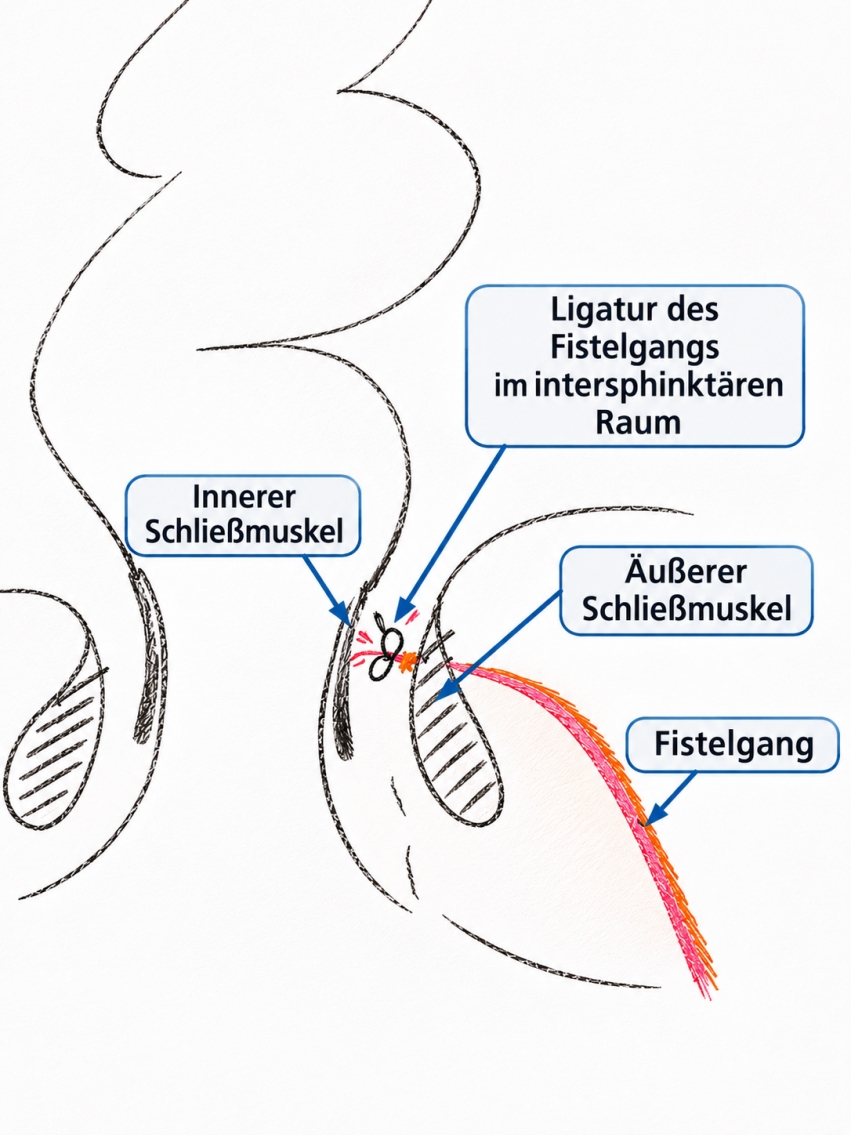
At our proctology practice, we have been using the so-called LIFT procedure to treat anal fistulas for some time now. This modern surgical technique is characterized in particular by its ability to preserve the sphincter muscle and the sensitive anal skin.
How does the LIFT procedure work?
LIFT stands for Ligation of the Intersphincteric Fistula Tract. In this procedure, the fistula tract between the internal and external sphincters is located and ligated. Only the external portion of the fistula tract is removed or opened. The sphincter muscles remain completely intact, and the sensitive anal skin is also largely spared.
Less Pain and Rapid Wound Healing
A particular advantage of this method is the minimal trauma to the tissue. Based on our experience to date, patients usually experience only mild postoperative pain, and the comparatively small surgical incisions heal quickly. The risk of impaired bowel continence is also very low.
Good, scientifically proven chances of success
Scientific studies show success rates of approximately 70 to 80 percent for the LIFT procedure, and even higher in some studies. These results are therefore quite comparable to those of other established surgical procedures, such as the advancement flap or fistulotomy with sphincter suturing. Studies also show favorable outcomes regarding postoperative pain and preservation of the sphincter muscle.
For which patients is this method suitable?
The LIFT procedure is particularly suitable for certain, anatomically accessible anal fistulas without complicated branches or side tracts. The procedure may also be an option for selected patients with chronic inflammatory bowel diseases such as Crohn’s disease.
Our own experience to date has been encouraging. Occasional superficial wound infections have so far been successfully treated conservatively. However, due to the still short observation period, we are unable to report long-term healing rates from our own data.
Our Conclusion
The LIFT procedure is a valuable addition to our range of surgical treatment options. In particular, the combination of good chances of healing, minimal pain, and preservation of the sphincter muscle makes this procedure attractive for suitable patients.
We determine whether a LIFT procedure is appropriate in each individual case through a thorough proctological examination.
Scientific Literature
- Emile SH et al. (2020): Ligation of intersphincteric fistula tract (LIFT) in treatment of anal fistula: An updated systematic review, meta-analysis, and meta-regression of the predictors of failure. Surgery.
- Bordeianou LG et al. (2022): The American Society of Colon and Rectal Surgeons Clinical Practice Guidelines for the Management of Anorectal Abscess, Fistula-in-Ano, and Rectovaginal Fistula. Diseases of the Colon & Rectum.
- European Society of Coloproctology (2024): European Society of Coloproctology guidelines for diagnosis and treatment of cryptoglandular anal fistula. Colorectal Disease.